Glutamate
The gas pedal. The brain's principal excitatory neurotransmitter. It increases neuron activity and underlies learning, memory, thinking, and the formation of new connections between neurons.
The gas pedal. The brain's principal excitatory neurotransmitter. It increases neuron activity and underlies learning, memory, thinking, and the formation of new connections between neurons.
The brake. The brain's principal inhibitory neurotransmitter. It slows neuron activity and supports calmness, relaxation, sleep, anxiety reduction, and protection from overstimulation.
Says "do that again." Involved in reward, motivation, pleasure, learning, attention, movement, and reinforcement. It tags an experience as worth repeating.
Steadies mood and rhythms. Helps regulate mood, anxiety, sleep, appetite, digestion, pain sensitivity, and the felt sense of well-being.
Blocks pain and brings relief. The body's natural pain-relievers. They reduce pain, create comfort or euphoria, and are released during stress, exercise, injury, laughter, or intense emotion.

images/methamphetamine.jpg
In the Beautiful Boy clip, Timothée Chalamet (playing Nic Sheff) shows apathy, exhaustion, anger, and a complete loss of motivation, the opposite of what dopamine normally produces. That points us back to dopamine as the disrupted system. Meth forces abnormally massive dopamine release, and the brain protects itself by downregulating receptors and depleting reserves. When the drug is gone, no natural dopamine signal is left, and the reward system runs empty.

images/heroin.jpg
In the Basketball Diaries clip, Leonardo DiCaprio (playing Jim Carroll) is in pain, sickness, anxiety, and rage, the opposite of the euphoric, pain-free state endorphins normally provide. Heroin's effect is not confined to the brain: μ-opioid receptors run throughout the peripheral nervous system along every pain pathway, an evolutionary survival mechanism for injury, escape, or childbirth that heroin hijacks, pulling GABA and dopamine along both centrally and peripherally. That is why withdrawal hurts everywhere at once, not just in the mind.

images/alcohol.jpg
In the Leaving Las Vegas clip, Nicolas Cage (playing Ben Sanderson) is in uncontrolled excitation, almost seizure-like. GABA is the brake and glutamate is the gas, so over-firing points us back to a collapse of GABA tone and a rebound of glutamate activity. Alcohol boosts GABA and blocks glutamate, so the body adapts by turning down its GABA receptors and ramping up its glutamate signaling. When the alcohol is removed, those adaptations are unmasked: tremors, anxiety, hallucinations, seizures, and in severe cases delirium tremens, which can be fatal.
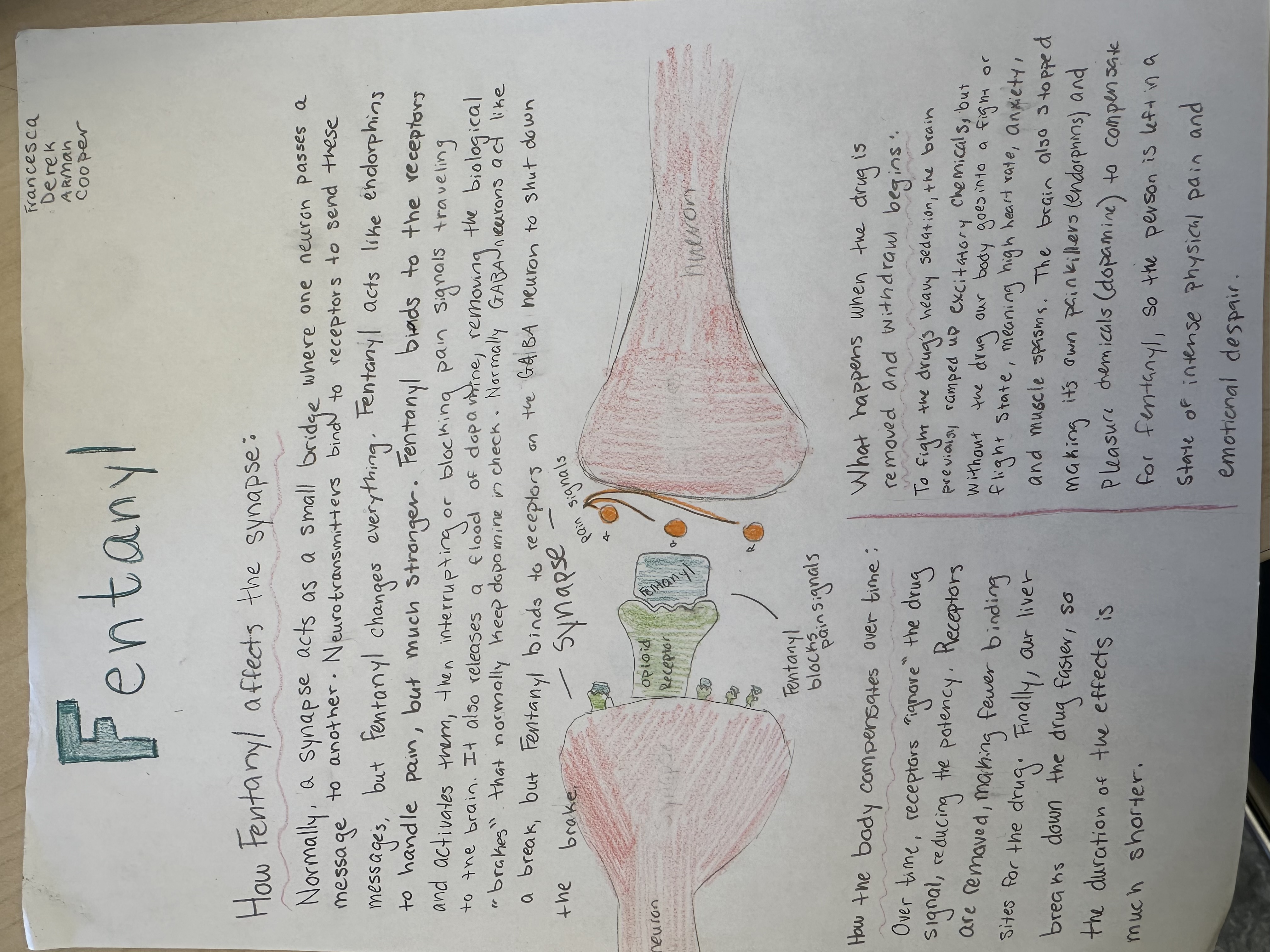
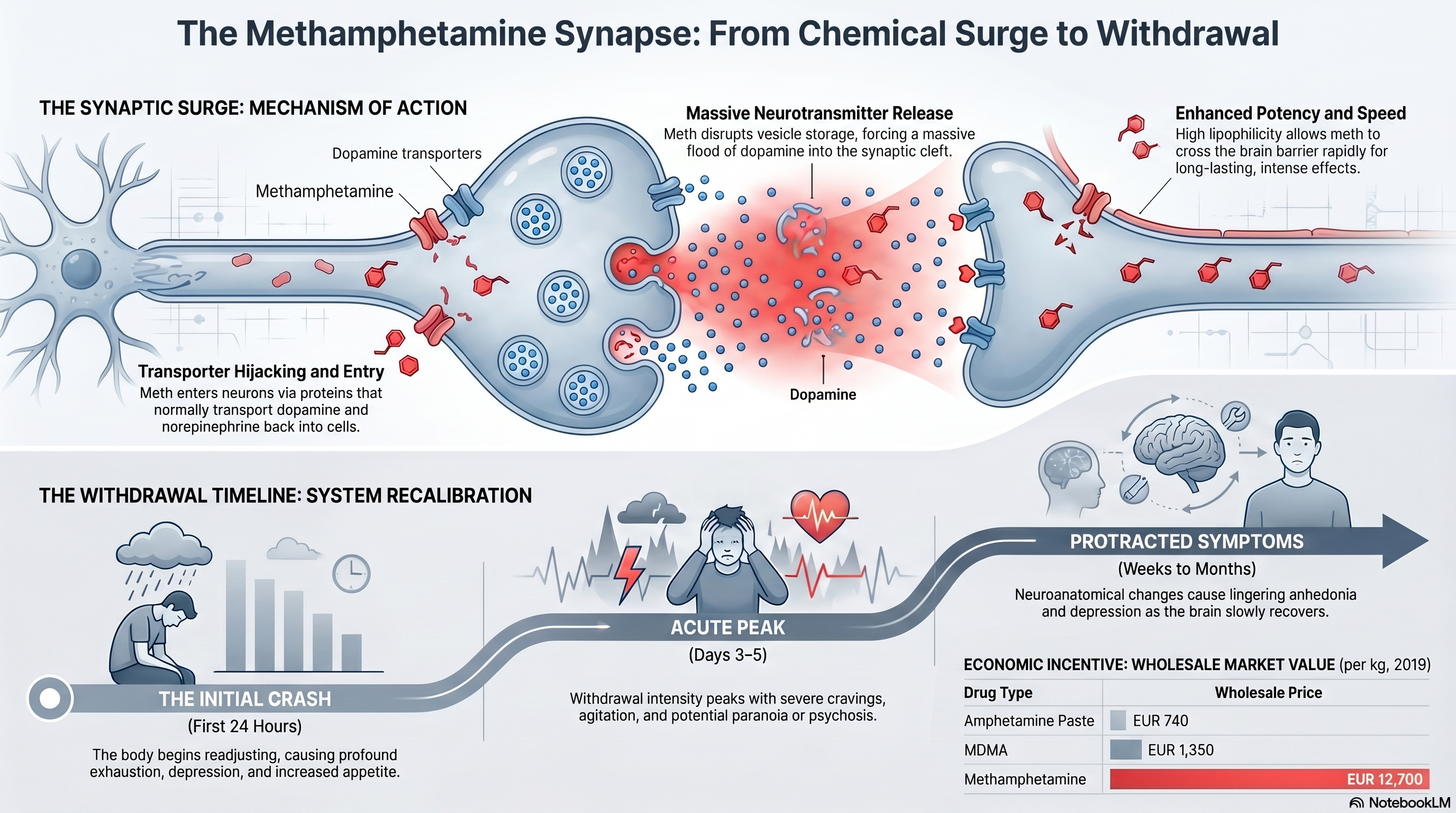
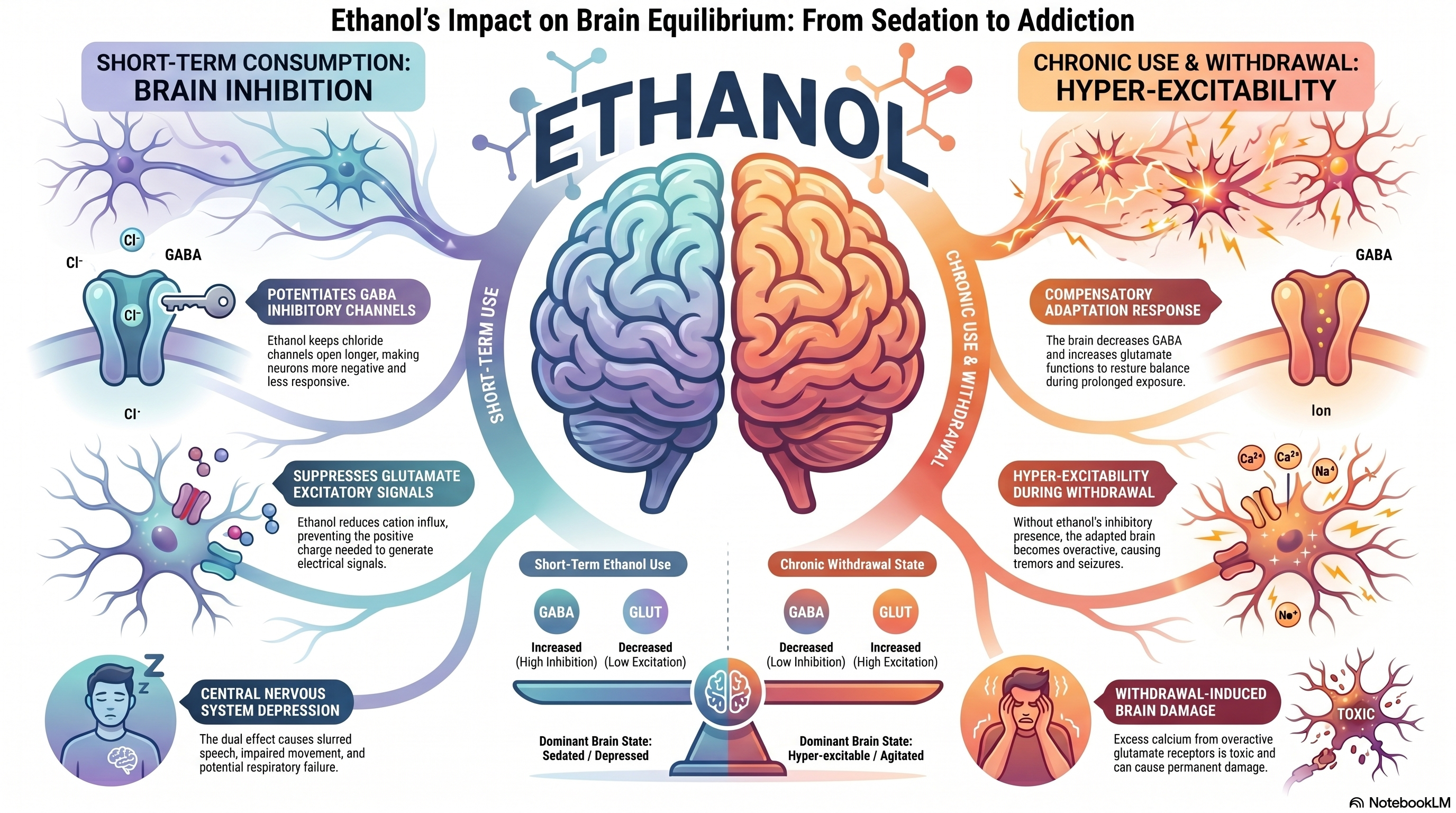
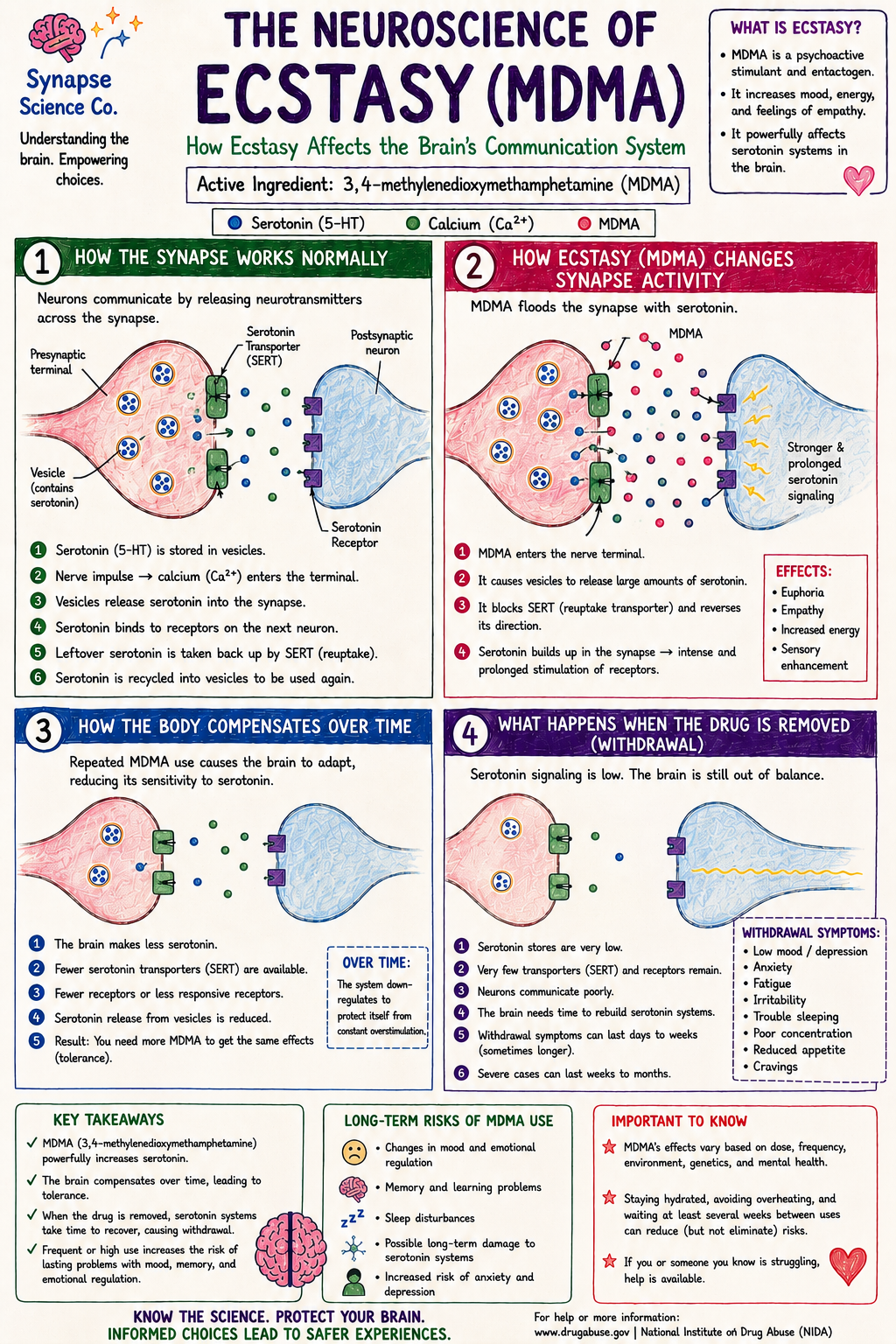
Of the addictive substances presented, only withdrawal from alcohol can be fatal. Based on what you learned about the neurotransmitters involved in withdrawal, hypothesize a reason for this.
Continued exposure to an addictive substance like methamphetamine leads to tolerance. The body senses an abnormal increase in the neurotransmitter involved and, rather than reducing the neurotransmitter itself, the body decreases production of the receptors that the transmitter binds to. Sensitivity drops, and more and more of the drug is required to reach the same state. Hypothesize why the body responds by lowering receptor sensitivity instead of lowering neurotransmitter production directly.
Of the drugs whose mechanisms were shown in Tab 3, methamphetamine and MDMA are the only substances that not only block reuptake of their neurotransmitter, but actively push more of that neurotransmitter into the synapse itself. Hypothesize a reason for this, looking at the two structures below.
Neuroscience of Withdrawal by Ramsey Musallam